UttaraPedia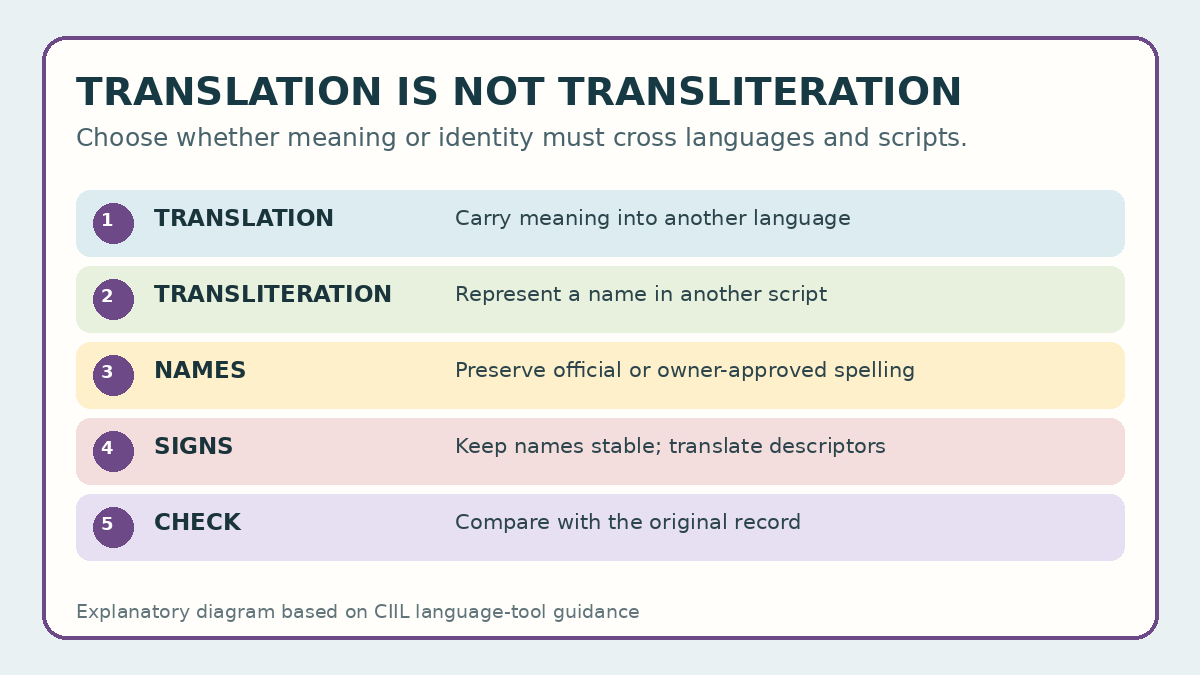
A sign says “Rajpath” in Roman letters. Should a translator turn it into an English phrase, or simply write the same name in another script? Usually a proper name needs transliteration, not translation. Translation carries meaning between languages; transliteration represents the sound or written form in another script. Mixing the two can change names, addresses and search results.
Translation changes language
When you translate “railway station” into Hindi, you choose Hindi words that carry the same meaning. Sentence order and grammar may change. A good translation should read naturally for its audience, not copy every source word mechanically. Context matters: “bank” beside a river is not the same as a financial bank.
Transliteration changes script
Transliteration aims to represent a name or word in another writing system. “Almora” and “अल्मोड़ा” point to the same place name in Roman and Devanagari scripts. It is not a word-for-word explanation of what Almora means. Transliteration is especially useful for personal names, station names, addresses and terms that must remain searchable.
One sound may have several Roman spellings
Indian names are not always represented by one universal Roman spelling. Long vowels, retroflex sounds and letters such as श, ष and स can be written differently under different schemes. The practical rule is to preserve the official or owner-approved spelling for identity documents, tickets, signs and directories. Do not “correct” a person’s name merely because another spelling looks more phonetic.
Script is not the same as language
Devanagari is a script used by Hindi and several other languages. Roman is also a script, while English and Hindi are languages. A font is only the visual design of letters. This distinction matters when a tool asks for source language, target language and transliteration separately. Choosing Hindi as a language does not automatically tell a system which Roman spelling you want for a name.
Use tools as drafts, then check
The Central Institute of Indian Languages describes Anuvadika as a platform combining translation, transliteration, language detection, speech recognition and speech output. That combination is useful, but language detection can make errors and names still need human confirmation. Compare important output with an official sign, document, dictionary or the person who owns the name.
A four-question editing check
- Is this a proper name, a general word or a full sentence?
- Must the meaning change language, or must the sound stay identifiable?
- Is there an official spelling already in use?
- Will the reader need the original script beside the new one?
For a bilingual sign, keep names stable and translate the descriptive part. For example, a site name may be transliterated while “entry gate” is translated. For a postal label or ticket, match the approved identity spelling exactly. For a learning note, show both scripts and explain pronunciation separately.
Our language, script and font guide gives the foundation. Try a draft in CIIL Anuvadika, then verify important names against the original. The useful next step is to mark each phrase T for translation or TL for transliteration before editing it; that small decision prevents many confident-looking mistakes.