
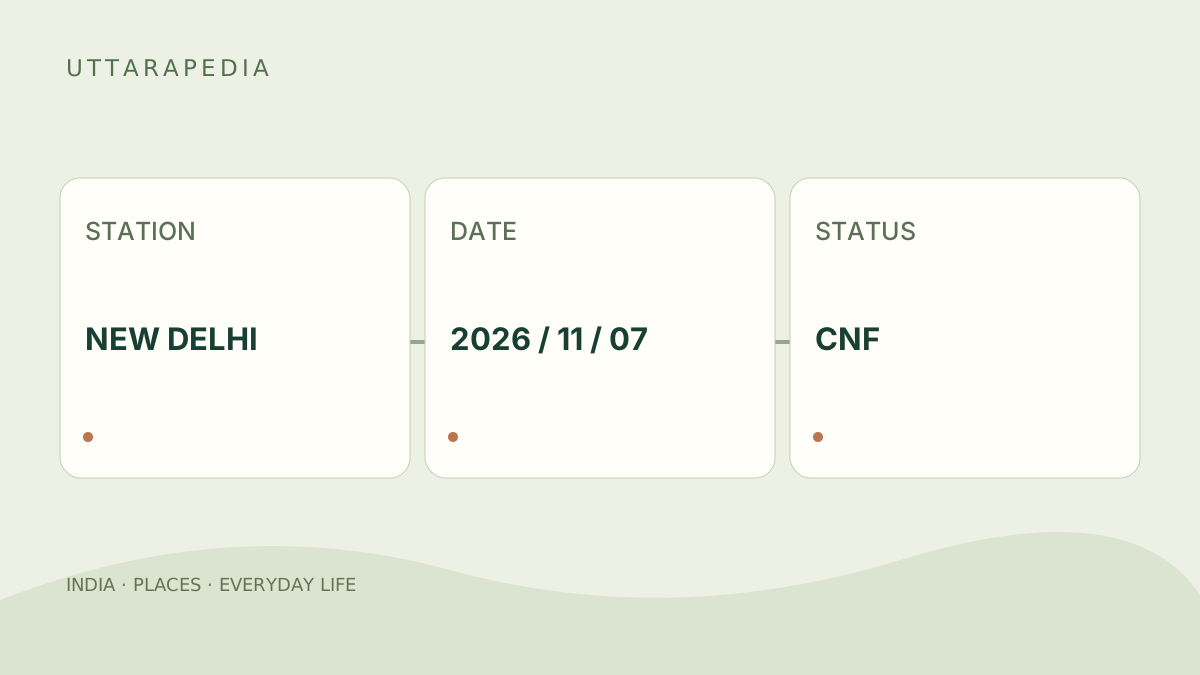
A train booking is only one part of the journey. You also need to reach the right station, know which calendar date applies to boarding and understand what your reservation currently says. Reading those details in a fixed order is more useful than keeping a screenshot that you cannot explain.
Start with the booking itself, then the official railway enquiry. Keep your accommodation address in a separate note: the city where you sleep and the station printed on a ticket are not necessarily the same destination.
First match the station, not just the city
Copy the full departure and arrival station names, together with their codes, exactly as shown. A city name in your itinerary is not precise enough for a driver or a booking search. If you change a search result, check the stations again instead of assuming the new train uses the same ones.
Create two short lines in your travel note: “hotel to boarding station” and “arrival station to next accommodation”. Put the agreed meeting point beneath the relevant line. This prevents a hotel address from being mistaken for the railway pickup location when you forward the note to someone else.
Write the boarding date in words
Indian Railways’ enquiry labels its boarding date DD-MM-YYYY. For readers used to month-first dates, rewrite it with the month in words. An illustrative entry of 07-11-2026 becomes 7 November 2026, not July 11. This example is a reading exercise, not an advertised service.
If boarding is shortly after midnight, identify the preceding evening as well. For an imaginary departure at 00:30 on 7 November, you would prepare during the evening of 6 November. Check the date and time for your actual boarding point; do not copy a time from another station on the route.
Keep reservation status separate from payment
Use the PNR on the booking to open the official current-status enquiry. Its fields distinguish the original booking status from the current status. CNF means confirmed; WL indicates a waiting list; RAC is a separate reservation status. Read the current official explanation of your result before making assumptions about accommodation.
A payment message is useful evidence of a transaction, but it does not replace checking the reservation. Likewise, a saved result tells you what the enquiry showed when you saved it. Check again near departure and review any message from the booking service. This guide does not estimate whether a waitlisted booking will become confirmed.
Check the class and the people travelling
Read the class shown in the booking rather than judging the train by its name or a photograph. Compare passenger names and the journey details against your own intended booking. Keep booking references private when asking a general question online; a blank example is enough to discuss what a field means.
For a group, nominate one person to read out the station, date and destination while another checks the booking. This small cross-check is especially helpful when several people have exchanged different screenshots during planning.
Leave a separate plan for the arrival
For a hill journey, the train’s arrival is the start of another leg. Record the onward destination, how you will contact the accommodation and what you will do if the arrival changes. Ask for current local advice before committing to a tight connection or a long onward drive.
Before closing the ticket, you should be able to answer four questions without guessing: Where do I board? On which date? What does the current reservation say? How do I reach my next overnight stop? Use the official links below for live enquiries; this article contains no live fares or timetable.