UttaraPedia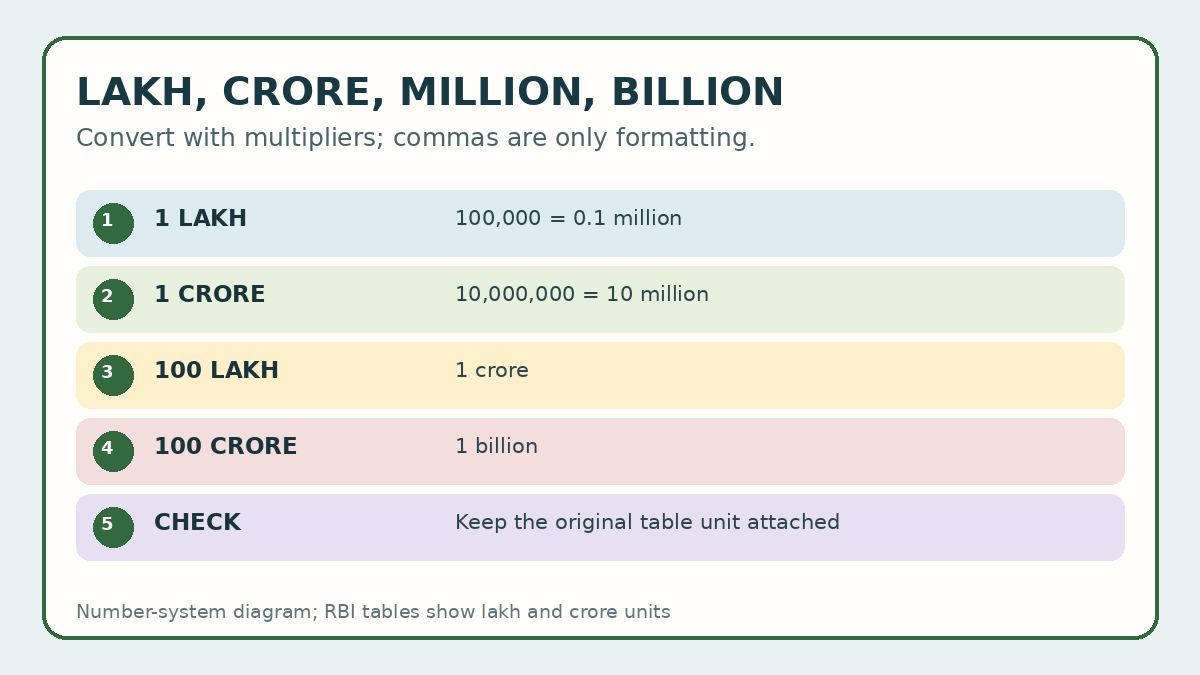
A report says ₹2,10,501 crore. How do you read it without moving a comma or confusing crore with million? First identify the numbering system. Indian notation groups the last three digits together and then uses pairs: 1,00,000 is one lakh and 1,00,00,000 is one crore. International notation groups digits in threes: 100,000 and 10,000,000.
Read the digits before converting
Remove the currency sign and unit for a moment. In 2,10,501 crore, the written number is two lakh ten thousand five hundred one, and “crore” is the stated unit applied to it. That is very different from ₹2,10,501 alone. Keep the original unit in your note until the final conversion.
Remember two exact anchors
One lakh equals 100,000, or 0.1 million. One crore equals 10,000,000, or 10 million. Therefore 100 lakh equals one crore, and 100 crore equals one billion. These anchors are enough for most conversions; you do not need to guess from comma positions.
Use multiplication, not comma replacement
To convert 7.5 crore into an absolute number, multiply 7.5 by 10,000,000: 75,000,000. That is 75 million. To convert 250 million into crore, divide by 10 million: 25 crore. A comma is formatting, not a mathematical operator, so changing Indian commas to international commas does not by itself convert a unit.
Watch crore-of-rupees tables
Official financial tables often put “₹ crore” in the column heading. Every entry is then already measured in crore. The Reserve Bank of India's currency table, for example, labels values in ₹ crore and volumes in pieces in lakh. Read the heading and footnotes before quoting one cell; otherwise a value or volume can be enlarged or reduced by a huge factor.
Decimals need the same care
0.25 crore is 25 lakh, 2.5 million or 2,500,000. 1.2 lakh is 120,000, not 1.2 million. Keep at least one full-number check beside a decimal conversion. For formal work, retain the source's precision and rounding note instead of adding false decimal accuracy.
A reliable four-line method
- Copy the original number and stated unit.
- Write the multiplier: lakh = 100,000; crore = 10,000,000.
- Calculate the absolute number.
- Express the result in the target unit and check the direction.
Example: ₹350 crore becomes 350 × 10,000,000 = ₹3,500,000,000, which is ₹3.5 billion. In the other direction, ₹48 million divided by 10 million per crore is ₹4.8 crore. If a table mixes value, volume and percentage, convert each column separately and keep the labels attached.
Our train-number and station-code guide shows why a number label is not always a quantity. Compare real financial formatting in the RBI currency table and use NCERT's official textbook portal for school-level place-value practice. Your useful next step is to build a tiny conversion box in your notes with the two anchors and one worked example; then every large number can be checked instead of guessed.